
The first hour after a wreck in Chatham County is the hour I watch people get the least right. Not because they're careless. Because nobody plans for it.
I'll say up front that it's easy for me to give advice from a comfortable chair, and that the person standing in the road is in a very different position. You may be in pain, or not know yet what's going on with you medically. You're in fight or flight, and people in fight or flight rarely make the right call. Whether the negligence behind your wreck is an ordinary car accident or something a great deal more serious, that first hour feels the same from the inside.
So this chapter is the short list I'd give you if you called me from the scene: what to do, in what order, and what to be careful about saying while you do it. None of it requires a law degree, and none of it requires you to be perfect either. I'd rather say that now than at the end.
We're still human beings, right? We still want to act like human beings and not let the legal case get in the way of being a decent person. I always recommend checking on the other person, making sure they're okay, even if they're the person who caused the wreck to begin with. We still want to be decent human beings.
The first hour, in the order it happens
Start with yourself, and not in some general sense. Okay means you don't need to be rushed to a hospital this minute. Check on whoever was riding with you, and if nobody needs an ambulance right now, you can move on to the rest of it. If you are willing, it is always nice to check on the others involved in the wreck, even if they were the cause.
Call the police if they haven't been called already. A lot of the time somebody who watched it happen calls before either driver thinks to, but if nobody has, make the call yourself and report what happened.
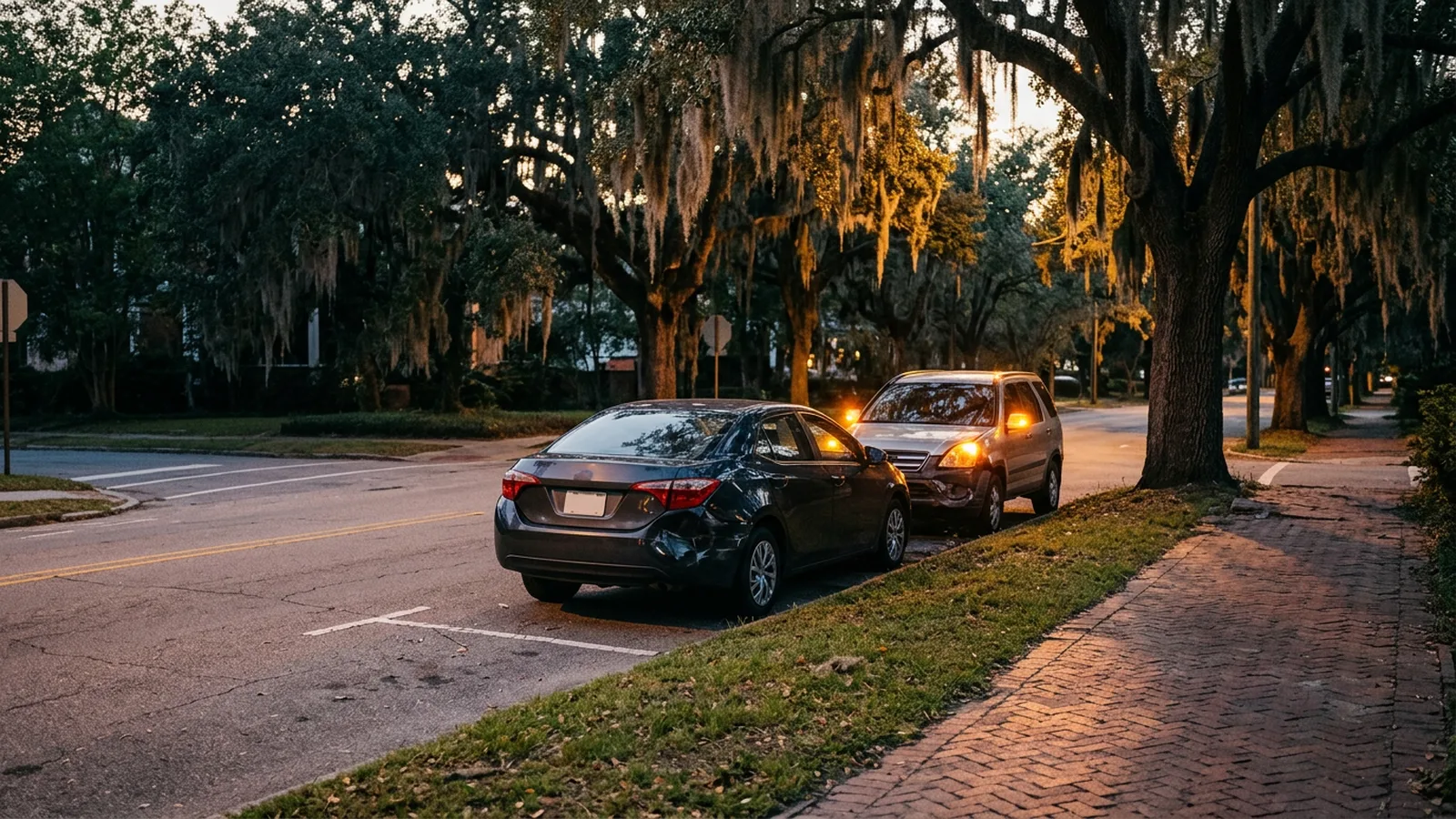
Then look at the scene and take pictures of everything before anything gets moved: the damage to your car, the damage to the other car, where the vehicles came to rest, the intersection, the road. Photographs cost nothing, and they capture a version of the scene that stops existing about ten minutes later.
When the officer gets there, describe the wreck and what you saw as accurately as you can. I know that's a hard thing to do with adrenaline running. It's still worth doing well, because that report gets written out of whatever the officer was told, and you want your account inside it.
EMS is usually right behind the police and sometimes ahead of them, and they deserve the same complete account. Tell them everything that's going on with you, not just the obvious things. A cut knee announces itself; tightness in the chest, a headache that started at impact, numbness running down an arm, none of those do. A paramedic can only act on what gets said out loud. And what you tell EMS at the roadside becomes the first page of a medical record that matters later, whether or not a lawyer ever gets involved at all. It's okay if you aren't quite feeling all the effects of the wreck, but try to listen to your body and what you're feeling at that time.
Be a decent person, then be careful what you say
Now, checking on the other driver belongs in that same first hour, and that one isn't a legal instruction so much as a human one. A wreck doesn't suspend your obligation to act like a decent person. Clients who have done exactly that, checked on the other driver, made sure everyone at the scene was accounted for, have never once told me they regretted it.
What changes the legal picture is what you say next. The instinct to apologize, or to guess out loud about who did what, is completely understandable. It's also the kind of sentence an insurer will hand back to you a year later. So talk to the other driver like a person. Ask if they're hurt, see whether you can help, and let the questions about fault wait for somebody whose job it is to answer them.
People sometimes assume Georgia protects an apology at the scene. It doesn't. The state does keep expressions of sympathy out of evidence, but only for doctors and other healthcare providers in medical malpractice cases. It does nothing for a driver after a wreck.
My mom is one of the sweetest ladies in the world. If a driver blew a stop sign and hit her while she was doing everything right, she would get out of the car and apologize to him. That's simply her nature. If she reads this, she's still going to do it. I'm not asking anyone to stop being that person. I'm telling you that an apology and an admission are two different things, and that a good lawyer can explain that difference to an adjuster or to a jury if it ever comes up.
Adrenaline will tell you that you're fine
Adrenaline complicates all of this more than people expect going in.
I had a client call me from the scene of her own wreck to ask what she should do next, and she happens to be a close personal friend. When I asked whether she was hurt, she told me she didn't know for sure but that she felt okay, and it had been a pretty bad wreck. She found out the next day that she had broken her wrist. The break was there the whole time and she simply couldn't feel it yet.
That isn't unusual, it's close to the normal response to a hard impact, and it's the reason insurance companies love the sentence people say at the roadside. What they like to do is point at you telling EMS or the police that you're okay. They hold it up as proof that you weren't hurt, or that you aren't entitled to anything.
Telling an officer you feel fine isn't a lie. It's often just wrong, in a way that has nothing to do with your honesty and everything to do with what a frightened body does under a shock like that. So as hard as it is with the adrenaline running, stop for a second and think about what actually hurts. Then say all of it out loud to whoever is standing in front of you.
Get checked out, then get checked out again
I always recommend getting checked out the same day, even when you feel "okay." If you'd rather not take the ambulance, that's fine; drive yourself, or have somebody drive you.
The biggest reason has nothing to do with a claim. It's to make sure you're okay, because you don't know what got jarred loose that you can't feel yet or if there is internal bleeding or brain damage that needs to be evaluated. My client went in feeling fine, they ran an x-ray, and there was the broken wrist: objective, no argument about it, and she never felt it happen.
Now, an emergency department is checking you for broken bones and for anything immediately life threatening. If you don't have either of those, they're going to discharge you, and that isn't them missing something. That's the job, and the job was never a full workup on everything a person might be carrying out of a wreck.
So in the days and weeks that follow, if you're still hurting anywhere, follow up with a general practitioner at minimum. Neck, back, shoulder or knee pain usually means you want an orthopedic surgeon, because they'll do a real evaluation and they often order an MRI. An MRI shows soft tissue detail in a way an x-ray can't, and it catches things an emergency physician was never going to find in that first visit.
Have "brain fog" post wreck? You might have suffered from a traumatic brain injury that could affect you for the rest of your life. While symptoms may present fairly earnestly at first, brain injury symptoms often develop over time. So it is important to get checked out early and often.
At every one of those appointments, tell the medical professionals everything. You might have ten things going on and report only the one that hurt worst that morning, which is how human beings work, and it's also what insurance companies use. They'll argue that you mentioned one thing, so the other nine must not have been happening. Nothing is too small to say out loud. You are your own best patient advocate, and nobody is going to advocate for you the way you can.
The form Georgia expects you to file
Georgia puts a reporting duty on you personally when no officer investigates the wreck. The threshold is five hundred dollars in property damage, which in today's world covers just about every wreck on the road.
If the police respond, they fill out the Uniform Motor Vehicle Accident Report, and nothing more is owed. The SR-13 is the self-reporting form. You have to fill out the SR-13 to self-report the accident when the police either weren't called or couldn't respond. Then you have ten days to file it with the Department of Driver Services. The form is available online.
That gap opened up wide during COVID, when departments simply couldn't get out to every fender bender. It's become less of an issue now, though it still happens on a smaller scale whenever call volume outruns the officers available to answer it.
Skipping the SR-13 requirement is technically a misdemeanor under Georgia law, though I've never seen it prosecuted against someone who was seriously hurt and unable to file in time. There are exceptions built in for people who could not possibly have complied. If you're hit and you spend eleven days in a coma, nobody expects a form to have been filled out from a hospital bed. In that situation there is almost certainly a police report covering it anyway. The obligation picks back up once you're able to act, and a good attorney handles that filing as part of taking over the case.
The more common cost of skipping it isn't criminal, it's practical. Call an insurer six months later about a wreck that was never reported anywhere, and the first thing they ask for is the accident form. When there isn't one, they get to question whether the thing happened at all.
One more piece belongs in that first day. Once you've hired a lawyer, the calls stop being yours to field: the other driver's insurer, sometimes an investigator, occasionally the police following up for more detail. You can tell any of them that you're represented and that they should direct their questions to your lawyer's office. That one sentence hands the paperwork to somebody else at the exact moment you should be focused on getting better. The last thing a person needs while they're healing, or while they're grieving, is a voicemail from a stranger asking them to explain the worst day of their year.
None of these steps require perfection, and I want to say that plainly before I get to the questions I hear most. Someone who said too much at the scene, or waited a day too long to see a doctor, has not necessarily lost a valid claim. No matter what happened and whether you think you made the right or wrong call in the moment, it can usually be fixed, and the right person will walk you through it. What's in this chapter is the ideal, not a checklist where one missed box ends everything.
Common Questions
- Should I talk to the other driver's insurance company before I have legal advice?
- Georgia doesn't require it, and I'd recommend talking to an attorney first. Your head is still spinning after a wreck, and people say things that aren't accurate simply because they're disoriented, not because they're being deceitful. You can be respectful and still tell an adjuster you're not ready to give a statement. Giving a recorded one before you understand how comparative fault works is a common way an early conversation comes back to hurt a claim.
- Do I have to call the police even for a minor-seeming crash?
- Yes, and the reason isn't the paperwork. The officer's report becomes the first documented account of what happened and roughly how it happened. If injuries surface a day or two later, which they often do, there is already a record that the wreck occurred. That's the same record my motorcycle and pedestrian clients lean on just as heavily.
- What if I'm not sure whether I was hurt?
- Then assume you don't know yet, because you probably don't. Adrenaline can mask real pain for hours, so get checked out the same day if there's any way to do it. The first reason is your health, and that would be true even if you never filed a claim at all. The second is that it starts a medical timeline on the day of the wreck, which is far harder for an insurer to wave off later as unrelated.
- What is the SR-13 form, and do I need to file it myself?
- It's Georgia's self-reporting accident form, required once property damage reaches five hundred dollars. If an officer responds, they write the Uniform Motor Vehicle Accident Report and you are done. You file it yourself only when the police weren't called or couldn't come out, and then you have ten days to submit it to the Department of Driver Services. You can complete it online, or your attorney can handle it for you.
- Can what I say to the other driver at the scene hurt my case?
- It can. Georgia keeps expressions of sympathy out of evidence only for doctors and other healthcare providers in medical malpractice cases, not for drivers, so an apology at the scene can be used against you. Keep the conversation at the scene to whether everyone is okay, and save your account of what happened for the officer and for your own attorney.
Chapter Reflection
Almost nothing in this chapter costs you anything. A few photographs. One more sentence to the paramedic. A phone call you make instead of assuming somebody else made it, and ten days on a form in the rare case where no officer comes out. What all of it buys is a record of your own wreck that somebody else can't quietly rewrite later. An adjuster you've never met, and sometimes twelve strangers in a jury box, will decide what happened out of whatever survived that first hour. And if you're reading this after the fact, having already said too much or waited too long, that's the sequence my contact page exists to help with. The next question, once insurance gets involved, is the one Georgia answers with a number: who was at fault, and by how much.