
Most people never read a police accident report until they're the one who was in the crash. In Chatham County, that report is filed by the Savannah Police Department or the Georgia State Patrol on Georgia's standard crash form.
Like most things in the law, how much it matters is a case-by-case question. But I can tell you the shape of the answer, and it surprises people both ways. The report is worth more than you think at the beginning of your claim, and a good deal less than you think by the time you're in front of a jury.
So this chapter is about the document itself. What goes in it, what an adjuster does with it, what a courtroom does with it, and what you do when it gets something about your wreck flatly wrong.
Certainly at the early portion of the claim, when you're working with an insurance company, it's very important, because insurance adjusters often don't do a thorough investigation. They just rely on whatever's in that police report. Police reports are often wrong or have inaccurate information, and that's probably what you're going to be working off of early on when trying to negotiate a claim before filing a lawsuit.
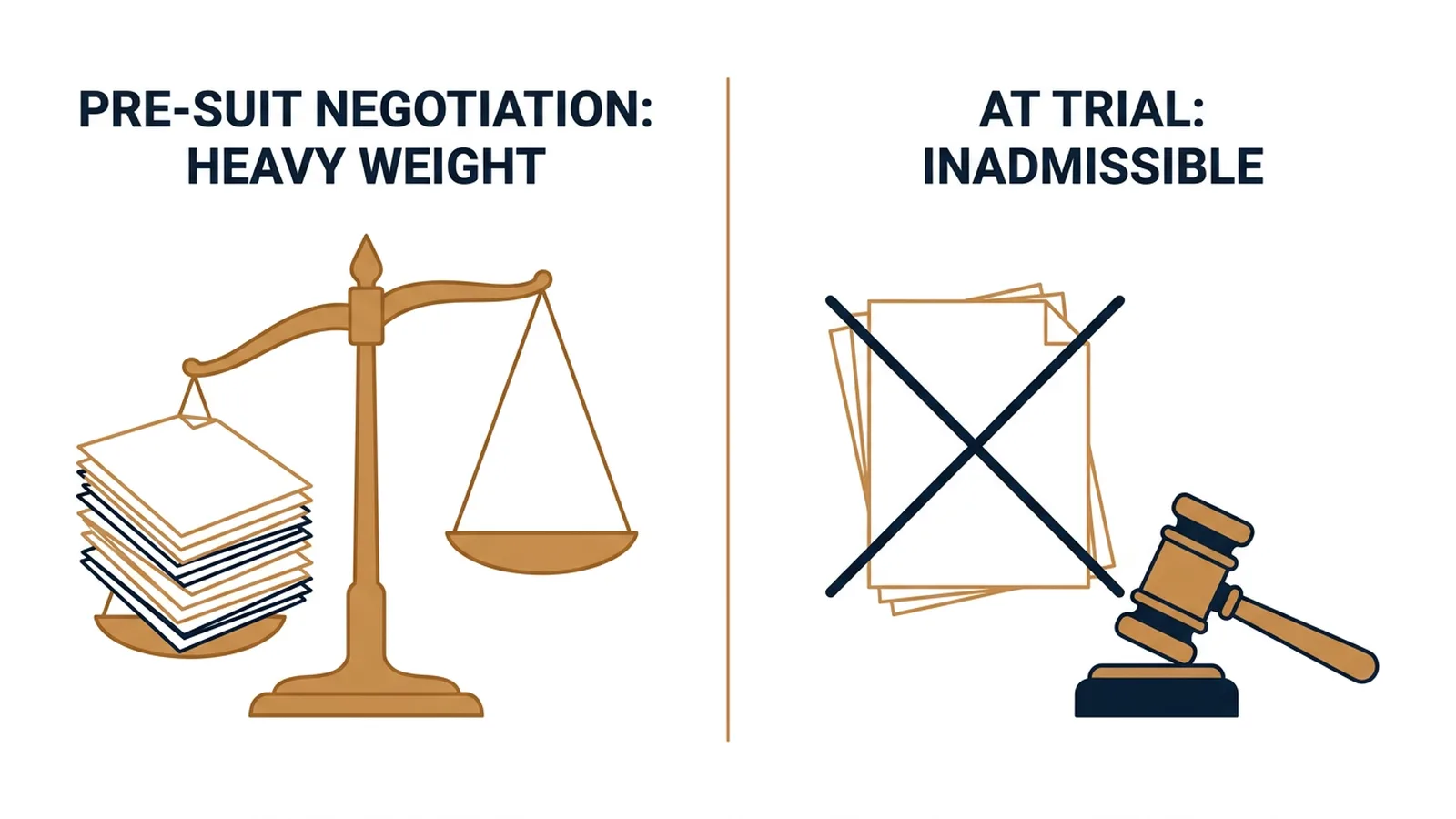
Heavy with an adjuster, light with a jury
Early in your claim, before anyone files a lawsuit, that report carries real weight with the adjuster deciding what your case is worth. Your average adjuster doesn't have a lawyer's credentials or a lawyer's background for investigating anything, so they lean on the crash report heavily. Whatever is written on it is very often what you're negotiating against.
Now, that's also the moment the report is least reliable. The officer wasn't there when it happened. Almost none of them ever are. Most of what lands on that form came out of drivers and witnesses standing in the road minutes afterward, stressed, sometimes hurt, telling it the best they can.
Then you get to trial and the weight flips. Much of what's in the report simply isn't admissible. If an officer didn't witness the wreck, they usually can't give an opinion on who caused it, and that opinion is the part everybody assumes is the important part. What they can testify to is what they personally observed. If they saw tire marks, they can say so, and they can give the measurements they took. If they talked to you or to a witness at the scene, they can tell a jury what was said to them as part of describing their own investigation.
So the same document is heavy in a negotiation and light in a courtroom. Knowing which stage you're standing in tells you how hard to push on it.
One piece of that cuts directly at you. If the officer wrote down that you said you were fine and you weren't hurt, the defense and the insurance company will hold that up to argue you couldn't possibly have been injured. We all know good and well what happens in a wreck. Your adrenaline is flowing and you don't yet know whether you're seriously injured. I have clients all the time who are objectively hurt and whose only thought at the scene was checking on the other driver, because they were trying to be a human being, which is a good thing. At the end of the day, like you hear on television, what you say can be used against you.
Everything a thorough report holds
The form is the GA Form 523. Nobody calls it that. We call it a Georgia motor vehicle crash report.
A thorough one holds a wealth of information: the weather, the road conditions, what each driver said in the confusion right after, the witnesses and their statements, and whether anybody got cited for causing the wreck. There are thirty or fifty separate things that can go on it.
My biggest frustration is opening one of those and finding that out of thirty or fifty fields, a couple got filled in. That tells me the investigation was thin. It doesn't tell me the wreck was minor.
The part officers often do a genuinely good job on is the diagram. Below all the coded fields there's usually a drawing: the two cross streets if it happened at an intersection, the reported direction each vehicle was traveling, and roughly how they came together. That picture has oriented an entire case for me. It puts the roadway in front of an adjuster, or in front of a jury, before a single expert opens his mouth.
So don't rely on the police to do your investigating for you. Do your own documenting, and do it at the scene.
When the report gets your wreck wrong
The report is wrong more often than you'd expect, and it is usually fixable. You won't have it the instant it happens; give it a couple of days to become available.
When it does, and you spot an error, call the officer. Their information comes with the report. Officers are human beings and they make mistakes, and most of them know it. If it was raining and it was midnight, they understand they may have gotten something turned around. So call and say, look, you put this here, but I think you'll recall it actually happened this way. What I've found is that most of the time they're reasonable about it. They'll tell you, oh yeah, I do remember it that way, I'm sorry, and they'll change it.
Some of what looks like a mistake isn't one. The form logs a lot of details as numerical codes rather than plain words, so a field that reads wrong on the page may be shorthand you can't decode. You might have no idea whether that number means the windshield wipers were on or off, or whether the road was wet or dry. A good attorney will help you read it, because there are subtle details in there you and I might discuss about your wreck that you'd never connect to a two-digit code.
I wish I could tell you there's a formal process for this. There isn't. It's calling, and calling again, until the right person at the department has time to sit back down with their own notes.
A report that blames nobody is not the end of your claim
I had a case last year that happened right on the Georgia and Alabama border where the responding officer didn't list either driver as at fault. He wrote that he couldn't determine who caused it.
On its own, that finding is close to fatal. The adjuster reads it and says, sorry, we have nothing showing our insured caused this, so we're not paying you anything.
We went and found a witness ourselves, using some forensics, and what she had to say built the whole case. She saw very specifically that the other driver ran a red light and smashed into my clients. Those injuries were serious. One person had a brain injury. There were several children in the car. There was a pregnant woman who had a baby the next day. It was an awful wreck.
I got her statement and took it to the police department, and the department amended the report to list the other driver as at fault. That amendment would have meant nothing at trial, because the fault determination is inadmissible either way. It meant everything to the claim. The insurance company paid its full policy limits, because it could now see that its own side had screwed up.
The other version of this is the case that stays open. I'm working one right now where a tractor-trailer hit my client on US 80 and fled the scene. We're fully investigating it. We've pulled video from gas stations, a liquor store, other nearby businesses. But the police have access to a lot of information we don't get until a lawsuit is filed, so we call that officer every day, giving him what we've found to help him finish his investigation and identify this driver.
Sometimes he doesn't call back right away. That isn't him ignoring us. They're busy people and they're human beings, and we want to give them some grace. We also want to stay on top of it. That's part of the job while your report is still unfinished business.
The file the other side is building
The insurer's work doesn't stop at reading the report either, and you should know that going in.
Once your claim is seriously disputed, adjusters and defense lawyers start gathering evidence of their own, and not all of it is collected as openly as an officer's investigation. They will get video surveillance on you. I've had it happen. A client wasn't being entirely honest with me about what his injuries were and what he could do, and he testified under oath that he could do X, Y and Z. Then at mediation, before trial, the defense attorney showed us up to three hours of video of him doing the things he'd said he couldn't.
So be careful. Be honest, and understand that there may be some guy sitting in the woods behind your house with a camera, trying to catch you doing something that contradicts what you've sworn to. That's an extreme example and most of my clients have nothing whatsoever to hide. Honesty from day one is the whole defense against it.
Not every adjuster handling a claim approaches it the same way, and it's worth saying so plainly. Some are seasoned professionals who'll look at a corrected report or a new witness statement and adjust their evaluation accordingly, because they've done this long enough to recognize when a file has genuinely changed. Others are newer to the job and tend to fall back on whatever the file already says rather than reconsider it, not out of bad faith but because they have less experience recognizing when their own first read was incomplete.
One last thing worth knowing about where all of this lands. The more disputes there are in your case, the more likely you are to end up in front of a jury. If they're only arguing about your shoulder while conceding the neck and the back, that case will probably settle. If they're disputing every injury, the causation, and who caused the wreck in the first place, that's the one that goes to trial. Recognizing which kind of case you're in early tells you a lot about how long this is going to take.
Common Questions
- Is the police report the most important piece of evidence in a Savannah car accident case?
- It matters most in the early negotiation stage of your claim, before a lawsuit is filed. That's when an adjuster is leaning on it to decide what to pay you. Once litigation starts, much of what's in the report becomes inadmissible, including the officer's opinion on fault, and other evidence carries more weight. It's an important document. It is not the end-all be-all of your case.
- Can I get an error in the report fixed?
- Usually, yes. Call the officer once the report is available, tell them what you believe actually happened, and most of the time they're reasonable about correcting it, especially with a photograph or a witness behind you. There's no formal appeals process, and I wish there were. In practice it means calling, and sometimes calling again, until the right person has time to revisit their own notes.
- What form does a Savannah officer use to document a crash?
- The GA Form 523, Georgia's standard motor vehicle crash report, though nobody refers to it by the number. It carries roughly thirty to fifty fields covering the drivers, the vehicles, the weather and road conditions, any citations issued, and the witnesses at the scene. It usually includes a hand-drawn diagram of the roadway too, which is often the single most useful thing on it.
- Can a weak or incomplete police report still support a strong claim?
- Yes. A report that says fault couldn't be determined, or that leaves out a witness nobody interviewed, is common. I had one on the Alabama line where the officer blamed neither driver, and the witness we tracked down ourselves turned it into a full policy-limits payment. An attorney investigating on your behalf can often build a stronger record than the report ever did.
- Does an insurance company only work from the police report, or do they investigate on their own too?
- Both. Adjusters lean heavily on the report, but once a claim is seriously disputed, insurers and defense lawyers build a file of their own, and that can include surveillance video of you. Be honest about what you can and can't do, and be consistent about it, and that kind of evidence never becomes a problem in your case.
Chapter Reflection
Nationally, more than six million crashes get a police report filed on them every year, and in Chatham County, that report is the first document nearly every insurance adjuster reaches for. The person reading it usually has no legal training and no way to investigate anything independently, so whatever is written there becomes the version of your wreck that gets priced. That's the whole reason it matters that you can change what's written there, and that you can add to it. A corrected field. A witness nobody interviewed. Video from the gas station on the corner. None of that requires catching anyone in bad faith, because a full investigation was never the officer's job in the first place. What the report can't do is prove what the wreck did to you. That evidence has a short shelf life, and most of it disappears while you're still standing in the road.