
A car accident case and a commercial truck accident case can look identical from the roadside and behave nothing alike once a claim starts moving. The gap opens before either injured person has hired anybody.
I don't tell people to rush in most cases. Some cases allow you to go through a grieving process, or to start healing, before you begin thinking about any of this. I do not say that about tractor-trailer wrecks. If you were in a serious one today, the most important thing you can do is hire an experienced attorney as soon as possible, and the rest of this chapter is why.
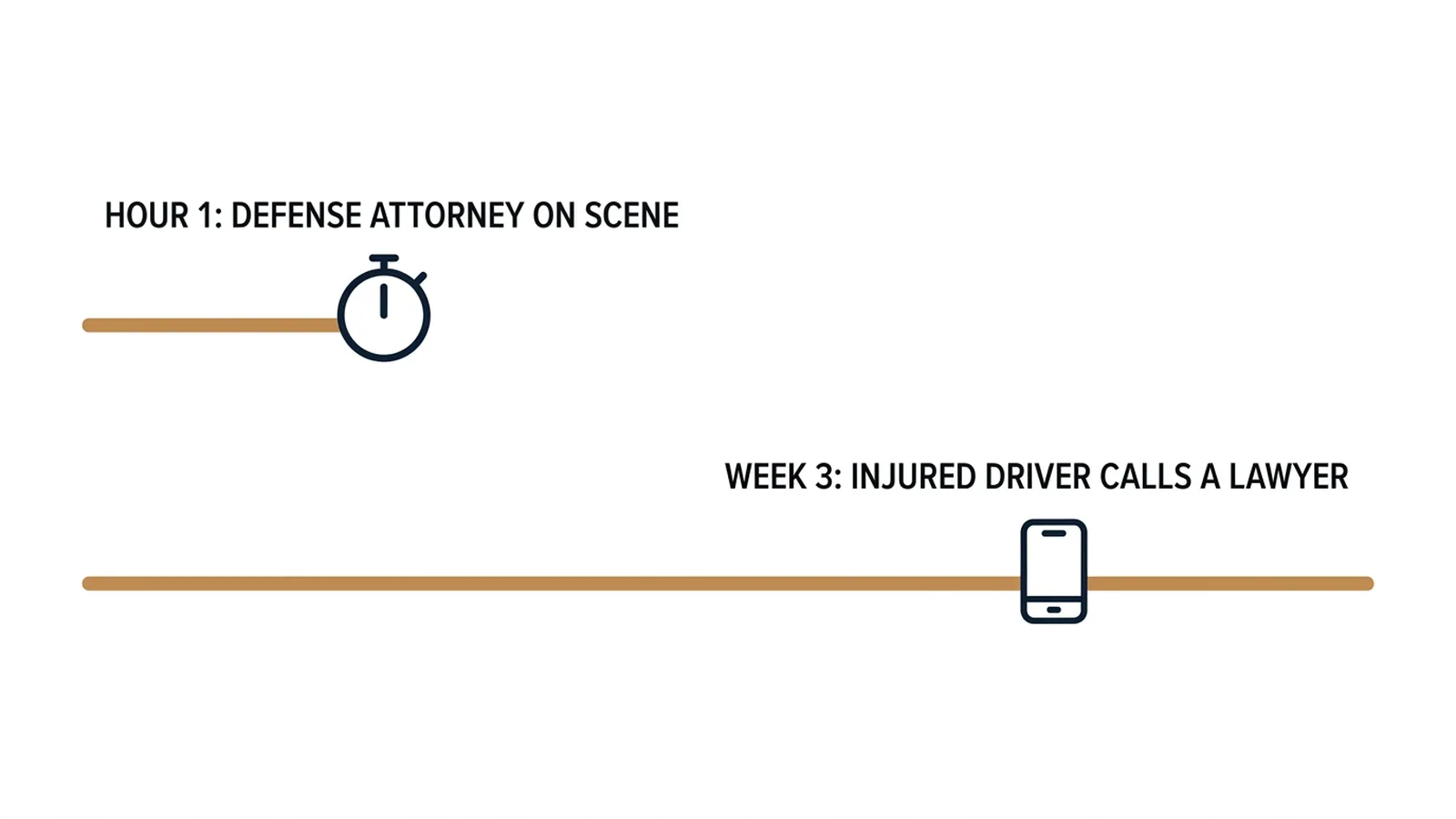
Even if you're prudent and you call an attorney the day after a wreck, I can almost guarantee you, in any serious tractor-trailer accident, the attorney for the defense has already been out to the scene. There are attorneys who are on retainer with tractor-trailer companies and insurance companies in Savannah who will get a call at 12:30 AM. If there's a tractor-trailer event that's an hour away, they'll send the attorney out there.
Who is already at the scene
Large trucking companies and their insurers keep attorneys on retainer for exactly this. That lawyer takes a call at half past midnight and drives an hour to stand in the road while the lights are still on.
So before your lawyer has ever heard your name, before anybody knows there's going to be a claim, they are investigating the scene and starting a narrative to reduce or eliminate your claims. They are talking to their witnesses and coaching them on what to say to the police, and on whether to go get that alcohol and drug test at all. That company also knows which federal regulations its driver and its equipment were supposed to meet, and knows exactly where its own paperwork might come up short if anybody asks to see it.
And they are deciding, early, which documents they would prefer you never see.
You're at a disadvantage on day one, and I'd rather say that plainly than pretend otherwise. What I can tell you is that it's survivable, and that with the right attorney you can not only mitigate it but turn it on its head and make it an advantage in your case. That's a question of how fast somebody moves, not of luck.
The first thirty days
First and foremost is the preservation letter, and it goes out broadly. To the trucking company, to the insurance company, to the driver individually, and to everybody who might have control of any records at all.
Third parties too. If your wreck happened outside a gas station with a camera that caught the whole thing, that business needs a letter. The driver may claim he had the green light, and there may be a camera that shows precisely how it went. Video records over itself in a matter of days or weeks, and without a letter the company can destroy evidence and then say they never realized there was a claim. At least that's what they'll claim.
The letter isn't a polite request. It tells them not to spoliate, which is a lawyer's word for destroying evidence, and if they destroy it anyway, there are consequences once we file suit. That's the whole point of sending it early. It creates the ability to hold them accountable later for records that no longer exist.
Second is talking to every possible witness, fast. If the Georgia State Patrol did a good job, their investigation will list the people who saw the wreck happen or who came up afterward and helped somebody who was hurt. Talk to those witnesses. Talk to the police. Collect the body camera footage and the dash camera footage from the officers, and start piecing it together.
Third, once the letters are out and some of that evidence is in hand, get a good expert involved. Someone who can take the black box data, the camera footage and the witness statements and reconstruct what actually happened, so you understand your own case early and know where to go with it.
And go stand at the scene. These are the cases where you want to see it yourself, get a feel for how it could have happened, and get your head around how things went down. I don't think that part can be done from a file months later.
If you're the one reading this in a hospital room, none of those three steps are yours to do. They belong to whoever you hire. Your only job is to make that call earlier than feels reasonable, because every one of those steps has a clock on it that started the moment the trucks stopped moving.
The black box keeps better notes than anyone
Just about every vehicle on the road carries one now, the small cars and the heavy trucks alike. Older equipment might not, but generally these days they all do.
The amount of data on it surprises people. You get the speed before impact, whether the driver tried to brake, and whether he was wearing a seatbelt. You also get details you'd never think to ask for, down to whether the air conditioning was running and whether the radio was on.
So if a truck driver says he was going fifty-five in a fifty-five zone and the black box says seventy-five, you have a significant piece of evidence. Either he is misremembering that day or he isn't being completely honest about it, and a jury gets to decide which.
Now, the data is generally correct, but interpreting it is another matter. Hydroplaning cases in particular get complicated. It is not as simple as printing it off and announcing what happened. Sometimes you need an expert to tell you what it means when one wheel is spinning and the other one isn't.
Driver logs, and the fatigue question
Driver logs answer a different question, and it's usually the one a jury most wants answered: why did this happen at all?
Sometimes the answer is simply that the driver was tired. He'd been on the road for twenty hours that day. Anybody would be tired under those circumstances.
Trucking used to run on handwritten logs. A sheet of paper and a pencil, and a driver tracking when he was driving and when he wasn't, with plenty of room to fudge it a little. Most fleets now use electronic logs that record the real time: when they're on the road, when they're driving, when they're in the cab.
Hours of service are one of the major pieces of the federal regulations, and there are maximums per day and maximums across seven to ten days. Drivers go over them, because that's how they make money, and going over is a violation. If the logs show that, you have a strong fatigue case and a real argument for punitive damages.
Even a driver who stayed inside the limits can be worth examining. He might have been five minutes under what the regulations allowed and still clearly been exhausted. It was the end of a long day. He should have pulled over and stopped driving, and instead he chose to push on, and it caused a catastrophic injury.
One more thing belongs in the same file as the logs. A truck driver has to undergo drug and alcohol testing after a wreck that kills someone, or after one where someone needs medical treatment and the trucker gets a citation for the accident. My understanding of the regulations is that the alcohol test has to happen within about eight hours and the drug test within thirty-two hours. I have found over my career that most of the time these companies do not comply with that. I think that's probably because they don't want to know the answer. When they skip it, that helps your case, because it lets you show a jury an irresponsible company and an irresponsible driver they have no reason to feel sorry for.
There are smaller signals too, and an experienced attorney knows to go looking for them. Did he have the air conditioning running? Did he just buy a cup of coffee, and can you pull the credit card receipt that proves it? Has he been driving a lot lately? Is something happening in his personal life that's cutting into his sleep? Did he drink the night before, which makes you more fatigued the next day even if you were nowhere near intoxicated at the wheel? All of it goes to the same question: should this man have been behind that wheel in the condition he was in.
The insurer is not automatically a defendant
There's one more reason to move early that has nothing to do with evidence. Georgia's rules about suing a trucking company's insurer directly have narrowed over the years, and I don't build a case around being able to do it. In some circumstances you still can, and when that's available I use it, because it simplifies a case that would otherwise mean chasing a company that's gone quiet. The safer assumption is that the insurer answers for the driver and the company rather than sitting there as its own defendant. That's one more reason the preservation letter has to reach the company and the driver individually, not just the carrier writing the checks.
Defense firms that have represented the same carrier for years can read a plaintiff's lawyer quickly, and what they're reading for is whether that lawyer has built a truck case before or is treating this like an oversized car wreck. Preparing it as though it's going to trial from day one, getting the reconstructionist in early, pulling the black box data before anyone can argue about its condition, does two jobs at once. It gets you ready for a jury. It also convinces a well-resourced defense team that settling for a fair number now costs them less than finding out later that your case was never going to fold.
Speed does not erase the head start. They were investigating while you were being loaded into an ambulance, and no letter undoes that. What it does is move you from purely reactive to competing on the same footing, with the letters out, the witnesses found, and the logs and the black box locked down before anybody has the chance to make them disappear.
Common Questions
- How quickly does a trucking company's insurer usually respond to a serious crash?
- Often within hours. Companies that operate commercial trucks keep lawyers on retainer specifically to reach a crash scene the same night, and I can almost guarantee that in a serious tractor-trailer wreck the defense attorney got there before your lawyer ever heard about the case. By the time you're thinking about calling anyone, they've already walked the scene and talked to witnesses.
- What is a preservation letter, and why does it matter this much in a truck case?
- It's a formal demand that the trucking company, its insurer, the driver, and any third party with relevant records not destroy evidence. It has to go out as early as possible, because video records over itself within days and driver logs get discarded routinely. Once that letter has been sent, destroying those records carries consequences in litigation rather than being written off as routine practice.
- Does hiring a lawyer quickly change the outcome of a truck accident case?
- It can, and this is the one type of case where I say that without qualifying it. An attorney who moves fast to preserve evidence can offset the defense's head start and sometimes turn it into an advantage. Wait too long and you lose the records the case depends on, which is not something a good lawyer can rebuild for you later.
- What does a truck's black box record, and how reliable is it?
- It records speed, braking, seatbelt use, and other data points around the moment of impact, down to whether the radio or the air conditioning was on. The raw data is usually accurate, but interpreting what it means, especially in a hydroplaning or mechanical-failure case, often requires an expert rather than a plain reading of the printout.
Chapter Reflection
Your truck case starts on an uneven field. Not because the law favors the trucking company. Because that company has been preparing for this exact day since long before it happened to you, and you had no reason to prepare for it at all. Everything in this chapter is a way of buying back the days you lost while you were in a hospital bed. None of it requires you to do anything except pick up a phone earlier than feels natural. What makes the field uneven in the first place is worth understanding on its own terms, because the same regulations that give the other side its head start are the ones that can take it back.