
Building an Evidence File the Insurance Company Cannot Argue With
I wasn't standing on the roadside when the crash happened. No lawyer was, no matter how fast you call one.
That's the whole problem this chapter is about. A lot of what a case gets built from exists only in a snapshot in time: the skid marks, the debris, the way the light was sequencing, the exact words a witness used before their memory softened into something more vague. By the time I open your file, some of it is already gone.
So the evidence you gather yourself, in the hour you least feel like gathering anything, matters about as much as anything I do afterward. Your lawyer and the experts we hire are only as good as what came out of that snapshot.
Once you hire an attorney, they're going to, hopefully, if they're a good attorney, do a thorough investigation, but they're not there at the scene with you. They can't gather a lot of the evidence that's only really there in a snapshot in time. If you're in an accident in Georgia or in Chatham County... absolutely document everything about the scene. Document the damage to any vehicles, document the witnesses.
What only exists in the first hour
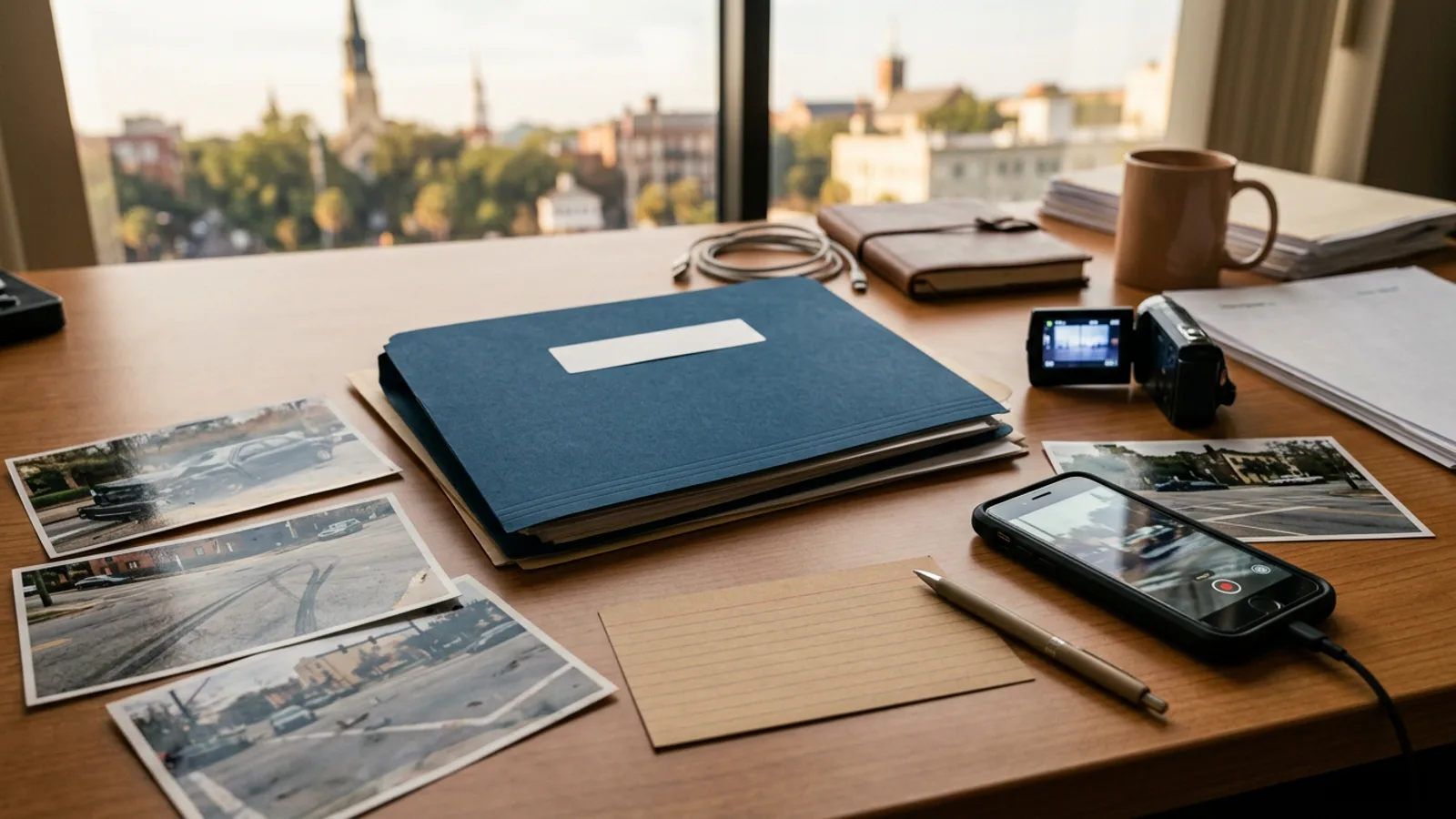
Document everything about the scene. The damage to the vehicles, whatever is lying in the road, and the witnesses.
Witnesses are the part people skip, and the police don't always get them. Believe it or not, officers leave witnesses off the report all the time, even when those people are standing right there with something to say. So get a name and a number yourself, and ask whether it's all right for you or your attorney to call afterward. A week later, that person is harder to find and less willing to be found.
Why that matters comes down to who a jury believes. If you say the other driver ran the light and they say you ran it, the two of you cancel each other out, because both of you have an interest in the answer. Jurors know that. A third party with no dog in the fight, somebody nobody at that intersection had ever met, carries a weight neither driver can. Identify a witness who supports your version and you will almost always win on liability.
I've got a case in litigation right now that's a he-said, she-said, and there were multiple witnesses at the scene. One of them was visiting from out of the country. The responding officers interviewed him, and he told them plainly that the other driver caused the wreck, not my client. But they never took down his information. So we don't have him. We can still rebuild that piece with reconstruction and forensics, and we are. But it would have been a lot cheaper and a lot easier with a name and a phone number written on somebody's hand at the scene.
Record what people are saying if you can. You don't have to be clever about it. Just say, hey, I'm doing this for my own memory. And write down or record your own account of what happened while it's still fresh, because your version at the scene is a version nobody gets to reshape later.
Now, your medical treatment belongs in this same file, and not only for your health. A consistent record of appointments and symptoms is what corroborates you. Insurance adjusters are only going to give you credit for what's documented in the records. Jurors don't work that way, and if you come across as honest, a jury will credit what you tell them from the stand. Even then, it is a great deal easier to say look what I told my family physician the day after, the one I've been seeing for twenty years, and it's the same thing I'm telling you now.
The pictures nobody thinks to take
The obvious photographs are half of it. Take pictures of the property damage, because that helps show forensically how the wreck happened. Take pictures of every visible injury: bruises, cuts, broken bones. That's how you establish what we call damages, the compensation you're going to ask for down the road.
The less obvious pictures are the ones that win arguments.
Photograph the roadway. If there are skid marks, I want those pictures. Shoot from both directions. If it happened at an intersection, take a video of the traffic lights running through their cycle, because signal sequencing turns out to be enormously important when the other driver says he didn't run the red. Lights change differently from intersection to intersection. A video of that sequence is what lets me and my experts reconstruct the scene and work out who actually had the green.
I have a tractor-trailer case right now where exactly that evidence is going to disprove the other driver. He says he didn't run a red light. The forensic timing of the signals says he very clearly did, and my client is very seriously injured.
Weather works the same way. If you've photographed the roadway in both directions and the cars and the lights, whether it was raining or dry is usually already visible in what you shot. That matters, because a driver who claims the road was dry looks different once you can prove it was wet and that he never gave himself room to stop. That one detail can be the difference between collecting nothing and being fully compensated.
Cameras have no memory to second-guess
Video evidence comes from more places than people expect: dash cams, business surveillance, doorbell cameras, and the responding officer's body camera.
Speed matters more here than anywhere else in your case. Businesses record over their footage, sometimes on a twenty-four-hour loop, sometimes a seven-day window. If nobody goes and asks quickly, the video that would have settled your case is gone. That's true when you're trying to identify a driver who fled, and it's true when the driver stopped, because a gas station camera that shows the other car running the red is even better than a witness who says so.
Then there are the body cameras, and this is an advantage we simply did not have fifteen or twenty years ago. People say one thing to an officer at the scene without registering that it's all being recorded, and then say something different under oath in a deposition. When those two versions don't match, that's compelling evidence that somebody is hiding something, and it bolsters your claim more than almost anything else in the file.
When a file includes body camera or scene video that's genuinely hard material, I tell the client plainly that it exists, that it belongs to their case and therefore to them. And that I don't think they need to watch it themselves. Most people in that position tell me the same thing: they want to know the evidence exists and that I've reviewed it, without having to relive it on a screen. That choice belongs to the client, never to me.
If it's in your chart, they will find it
Insurance companies and defense attorneys will comb your medical history for anything that lets them argue your injury came from somewhere other than this wreck. They will absolutely do it.
Degenerative disc disease is their favorite. I'm thirty-seven, which is pretty young, and I have degenerative disc disease. Almost everybody over twenty-five does. It's a normal condition of a spine that has been in use, and it proves nothing. The defense raises it anyway, hoping to confuse a jury into believing that a quiet, symptomless condition is what's causing your pain now. What actually matters is that it took a trauma to make it painful, and that's a distinction a jury understands perfectly well once somebody bothers to explain it.
An old injury to a different part of your body gets the same treatment. You hurt your neck in a wreck years ago, you hurt your back in this one, and they will still try to tell a jury the two are the same thing.
Here's how far it goes. If you sneezed one time thirty-five years ago and a doctor wrote down that your back hurt because of it, they will point at that note and say the sneeze is what caused your back injury, not the ten-thousand-pound tractor-trailer that ran into you. I'm not exaggerating that example. Said out loud it sounds absurd, and it is absurd, and a jury with no context can still be talked into taking it seriously unless somebody stands up and unpacks it.
Where experts come in, and what they cost
Sometimes the scene doesn't produce enough on its own, and that's where experts fill the gap between what a photograph shows and what a jury needs to understand.
You can come to trial and say your leg hurts. You cannot say, on your own authority, that the pain comes from a herniated disc this wreck caused. That takes medical causation testimony, usually from the orthopedic surgeon or the neurosurgeon who treated you.
When liability is disputed, an accident reconstructionist goes through an actual scientific process. They measure skid marks, look at the timing and sequencing of the lights, evaluate the witness statements, and study the crash damage, then tell a jury how the collision happened. Sometimes nobody is lying and nobody remembers, because someone had a brain injury or someone didn't survive. The forensic evidence still knows. They can read the force from the damage to the vehicles, and a tree knocked down at the roadside is its own rough measure of how hard something hit it. The same expert matters in a road defect case, a hydroplaning incident, a pothole that put you off the road, or a tire that blew out. We use accident reconstructionists on almost every case.
And when the defense says the property damage doesn't look that bad, a good biomechanical engineer can explain how that much force moves through a body like yours, and why you hurt the way you do regardless of what the bumper looks like.
Experts get expensive, and most people have no idea how expensive. I've had cases carrying five or six hundred thousand dollars in expenses before trial. Car wreck cases are usually much cheaper, twenty to twenty-five thousand, sometimes less. I cover all of it on the front end, so my clients never risk that money, and it's reimbursed out of the recovery at the end. You don't want an attorney looking for a discount when your case needs the right expert. You also don't want one spending without thinking, because at the end of the day it comes out of your recovery. The goal is the right expert, not the most expensive one.
One more thing about how all that evidence gets used, because gathering it is only half the job. Some lawyers leave out what would have moved a jury. Others bury the jury in every photograph and every record the case ever produced and mistake that for thoroughness. Jurors took time away from their own lives to sit in that box, and they notice. I tell them upfront that I'm going to show them everything that matters and do it quickly, because I appreciate that they have families and lives they want to get back to. Jurors have come up to me after trials and said they felt I was there to advocate for my client and not waste their time, and that the other side was there to waste it. They get mad when you waste their time.
Common Questions
- What should I photograph at the scene if I'm able to?
- Vehicle damage from multiple angles, the road and surroundings, your visible injuries, and anything relevant to how the crash happened, before anything gets moved or cleaned up. Add the two most commonly missed ones: skid marks photographed from both directions, and a short video of the traffic light running its full cycle if you were at an intersection. That sequencing is what lets an expert reconstruct who had the green.
- Why do witnesses matter so much if the police already took a report?
- Because officers leave witnesses off reports all the time, even when those people are standing right there. And because a witness with no stake in the outcome breaks a tie that you and the other driver can't break between yourselves. Jurors know neither of you is neutral. Get a name and a number at the scene and ask whether your attorney can call.
- Does going to my medical appointments help my claim?
- Yes. Adjusters only give you credit for what's documented in the medical records, so a consistent treatment history is what corroborates the injury you're describing. Jurors are more forgiving than adjusters and will credit honest testimony. Even so, being able to point to what you told your own doctor the day after the wreck makes the whole thing far easier to prove.
- Will the insurance company use my past injuries or medical history against me?
- They'll try. A preexisting condition, even a common one like age-related disc degeneration, doesn't disqualify a new injury your crash caused. What matters is whether the wreck turned your quiet condition into a painful, disabling one. I've seen them reach back thirty-five years to a note about a sore back and argue that, rather than the collision, is the real cause.
- What kind of video evidence can help my case beyond my own photos?
- Dash cams, nearby business surveillance, doorbell cameras, and police body camera footage can all corroborate what happened to you. Body camera footage in particular catches inconsistencies between what someone said at the scene and what they say later under oath. Move fast on the business cameras, though, because a lot of them record over everything within twenty-four hours.
Chapter Reflection
A case gets built from what's in the file, not from what a person remembers under oath a year and a half later. Most of that file is created in the first hour by somebody who is shaken up and would rather be anywhere else. And if I had to name the single most important factor in one of these cases, it wouldn't be a photograph or an expert report. It would be you. The likability of the plaintiff is the most important factor I know of. That said, a likable plaintiff with all the other evidence running against them still has a tough hill to climb, which is exactly why you develop every other piece of it. That window closes faster than it sounds, and it closes fastest of all when the vehicle that hit you was a commercial truck. The company on the other side is not waiting on you to start building its file.