
People ask me why their friend's case was worth more than theirs when the injuries look about the same. A lot of the time, the answer is that their friend got hit by something heavier.
There are three reasons a tractor-trailer case behaves differently from a car case, and the first one is the obvious one. When you get hit by something that weighs what a heavy truck weighs, you're going to be more hurt. That's physics and that's force, and it's why serious injuries and deaths are so much more likely in these wrecks than they are if a Mazda 3 hits you.
The other two reasons are less obvious, and they're the ones this chapter is about.
When I was a young lawyer and I was working for another attorney and I had my first tractor-trailer case, I said, well, how do I learn, how to handle one of these tractor-trailer cases? He said, well, you should learn the federal regulations, 'cause if you know the regulations, you know what standards they are held to. I spent the next week reading every single word of the FMCSR, which is a book that's this tall and this wide and very thick, and learned every single aspect of it.
A rulebook ordinary drivers never see
You and I obey the rules of the road, and that's about it. Nobody limits how long we drive. Nobody makes us take a drug test.
A commercial driver lives under the Federal Motor Carrier Safety Regulations, which exist because Congress passed the Federal Motor Carrier Safety Act and handed a federal agency the power to write and enforce them. Hours of service. Mandatory drug and alcohol testing after a fatal wreck, or after an injury wreck where the driver is cited. Medical certification. Pre-trip and post-trip inspections, with a checklist and a form.
They very seldom abide by all of it, and that gives you something an ordinary car case never offers you.
That matters to your case in a specific way. Even where the injuries are identical, a truck case can be worth more than a car case, because the truck case may carry an element of punitive damages that the car case simply doesn't have. The other side didn't just hurt you. They hurt you while ignoring a standard they agreed to meet in exchange for being allowed on the road at all.
Medical certification is one of the more specific pieces of that scheme and it comes up more than people expect. I believe a commercial driver has to be certified every twenty-four months, and some have to do it every twelve, depending on whether they have a condition that warrants closer monitoring or an eyesight issue. Put a driver back out there without a current certification, or ignore something that should have triggered the shorter cycle, and that failure becomes part of your case.
I learned this material the way the quote above describes, because a lawyer I worked for told me that if I knew the regulations, I'd know the standard they're held to. That's still the advantage. In litigation you need somebody who knows what those standards say, can tell when they weren't met, and puts that at the forefront of the case rather than treating it as background.
Everybody who could be on the hook
The driver who hit you is the obvious defendant, and he is rarely the only one you can go after for large sums of money.
The company is next, whether he's an employee or what we call a statutory employee, meaning he's driving on their behalf. In some circumstances you can still hold the insurance carrier directly liable in Georgia, though the law there has moved around over the years.
And then there's the least obvious one. The United States Supreme Court came out with a decision confirming that you can recover against a broker, the company that placed the driver with the trucking company in the first place. Brokers have standards that apply to them too, and if they don't act prudently, you can hold them responsible for putting a dangerous driver on the road.
Underneath all of that sits an obligation nobody advertises. Trucking companies, brokers, and sometimes even insurance companies are required not to be negligent about who they hire. They're supposed to run background checks and find out whether this particular driver has a pattern of reckless or dangerous driving. Skip that, put a dangerous person on the road under your placard, and that's negligent hiring.
Negligent retention is the version that happens later. You find out after you hired him that he's reckless, and at that point you have an obligation to stop employing him, or at minimum to stop putting him where he can seriously injure or kill somebody. Keep him out there anyway and you own what happens.
A habitual drunk driver is the cleanest example. If the company's own records show a history of it and they kept him on the road, a jury doesn't need much help working out why the company is responsible and not just the man behind the wheel. That pattern is also one of the most direct routes to punitive damages, because it shows a company that wasn't careless in one moment but consciously indifferent to a risk it already knew about. A habitually intoxicated driver kept on the road is also precisely the fact pattern where the two-hundred-fifty-thousand-dollar punitive damages cap disappears fully under Georgia law, covered in more detail later in this book.
I try to ask, in every case, whether the wreck traces back only to a driver's split-second decision or whether something upstream made that decision more likely to end in tragedy. A defective tire. Maybe nobody maintained the road. Maybe nobody ever ran a background check. Don't just look at the low-hanging fruit. Look at the totality of the circumstances, because a truck case rewards that habit more than almost anything else I handle.
What goes wrong before the truck ever leaves the lot
The regulations don't only govern what a driver does while he's driving. They govern what happens while somebody is packing the container.
Overloading is the one you can picture. Too heavy and it changes how quickly you can stop. A driver might be following at what would be a safe distance at a normal weight, and then somebody brakes in front of him, and the truck simply cannot stop in that space. Packing it unevenly is the other one, and that's what flips a trailer or sends it fishtailing without the driver doing a single thing wrong at the wheel.
So who loaded it becomes a real question, and sometimes a products liability question. Sometimes the driver packs his own trailer. Sometimes the container arrives pre-packed, which means whoever packed it can be held liable for what it did to you.
Maintenance works the same way. A driver is supposed to run a pre-trip and a post-trip inspection every single time, with a whole checklist: tire tread depth, whether the tires have enough air, mechanical defects, lights working at night. Stop for gas and he's supposed to do another one before getting back on the road. Rarely do they actually do it. There's a form they're supposed to fill out, and when they don't, things get missed. You can drive prudently at a safe speed and a safe distance and still cause a wreck because you never checked your brakes or your tread depth, and you can be held liable for exactly that.
Then there's the shop. Maybe it's a Freightliner dealership, maybe it's a mom-and-pop place doing the maintenance. If they negligently maintain the vehicle or miss a defect, they're liable too. I've had one where they forgot to put the lug nuts on a wheel, and that wheel came off and went through a poor woman's front door. The driver did nothing wrong in that case. The company that put the tire on is who we brought the case against.
Where these wrecks happen, and where you end up
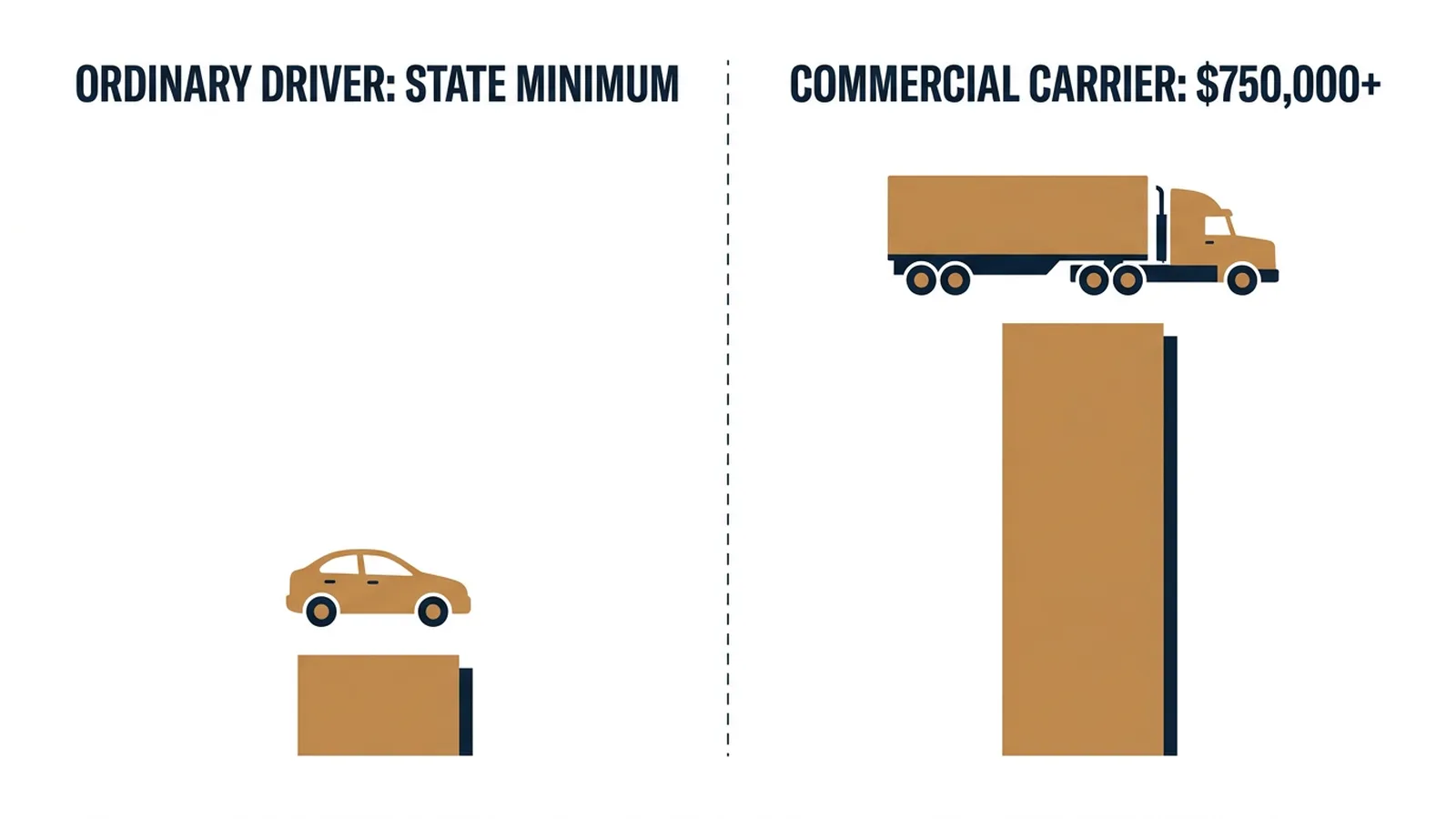
Insurance requirements track the same difference in scale. A typical Georgia driver carries a state minimum liability policy. Commercial trucking companies don't. They're usually required to keep at least $750,000 in coverage, and in some circumstances as much as $5 million, because the potential for catastrophic harm is so much greater. Plenty of these companies carry more than the floor voluntarily, because they're large operations that understand their own exposure.
So if Client A comes in having been hit by a mom in a Honda and Client B comes in having been hit by a loaded tractor-trailer, I can tell you almost before I know the details that Client B will have more insurance available. That's one of the clearest reasons two people with comparable injuries walk away with very different numbers.
Coastal Georgia adds its own layer, which is why my trucking practice treats I-16 and I-95 differently from an ordinary two-car claim. I-16 runs from Savannah toward Macon, and I'd call it one of the most dangerous roads in America and certainly the most dangerous in Georgia. The reason is the Port of Savannah, which we're very proud of, and which is one of the busiest container ports on the East Coast. All those containers have to get from point A to point B, which means a great deal of heavy truck traffic on the road you drive to work. That volume of commercial trucking on I-16 and I-95 shapes both how often these crashes happen here and how I have to move on the investigation.
Where you get treated matters too, because the injuries here are so often severe, and you don't get to choose in the moment. Memorial Hospital in Savannah is, I believe, a trauma one center, and it can handle the significant majority of the catastrophic cases we see. The worst ones sometimes get life-flighted to Atlanta or over to Jacksonville, where there are bigger hospitals. Fires happen in these wrecks, and a bad burn case often means the Augusta Burn Center instead, because that level of specialized care goes past what a regional trauma center provides. Medical bills in those cases run into the tens and hundreds of thousands of dollars, and in the worst collisions, into the millions.
All of that is why a truck case carries more experts than a car case. You can have five, six, seven of them. An accident reconstructionist. A safety expert from inside the industry, or a former driver who can tell a jury how these standards work in practice. A life care planner and an economist to price what the rest of your life now costs. And your own treating physicians on top of that. Georgia's evidence code, under O.C.G.A. § 24-7-702, gives the court a gatekeeping role over which experts are qualified and reliable enough to testify at all, which cuts both ways: it can exclude an unqualified expert the defense tries to put forward just as easily as it can exclude one of mine, which is exactly why choosing the right experts, not just any experts, is such a central part of building one of these cases.
Common Questions
- Why is a truck accident case usually worth more than a comparable car accident case?
- Three things stack up. You're likely to be more seriously hurt, because of what a heavy truck weighs. There's far more insurance behind it, since commercial carriers usually have to hold at least $750,000 against an ordinary driver's state minimum. And a violation of the federal safety regulations can put punitive damages in play, which a car case almost never carries.
- Who besides the driver can be held responsible after a Georgia truck accident?
- More people than you would guess. The trucking company is the obvious one, and so is whoever loaded or maintained the vehicle. The broker who placed that driver with that company can be liable too. If a pattern of dangerous driving existed and somebody ignored it, you may reach the employer for negligent hiring or negligent retention, and in some circumstances you can reach the insurance carrier directly.
- What role does the Port of Savannah play in these cases?
- It puts significant commercial truck volume on I-16 and I-95 through Chatham County, which shapes both the frequency of serious truck crashes here and how quickly you and your lawyer have to move to secure evidence. The port is one of the busiest container ports on the East Coast, and every container leaving it travels by truck.
- Can a maintenance company be held liable instead of the truck driver?
- Yes. If a mechanic or service company fails to properly keep the vehicle, such as improperly securing a wheel, you can base a claim against the maintenance provider even when the driver did nothing wrong. I've handled exactly that: the lug nuts were never put on, the wheel came off, and it went through the front door of a woman's house.
Chapter Reflection
A truck case runs under a different rulebook, a different insurance floor, and a different clock than a car case. Treat it like an ordinary wreck and real value gets left on the table, most of it in places you'd never think to look. What I learned reading that thick book as a young lawyer still holds up. Learn the standard somebody is held to and you have your questions ready for the day they didn't meet it. Knowing where to look is one half of the job. What all of it eventually gets converted into, a number a jury writes down, is a separate question, and it's the one everybody wants answered first.