
The most important question in this area of law is also the hardest one to answer. Did what happened to you actually amount to medical malpractice?
Sometimes I can answer that fairly quickly. Sometimes it takes extensive expert review before anybody knows. And the simplest way I know to explain it is this: sometimes bad things just happen, and it isn't because a doctor or a nurse did anything wrong.
That's the conversation I dread having, and I have it often. A family's grief is real and their instinct that something went wrong is frequently correct, and I still have to tell them plainly that a bad outcome and a provable case are two different things. Anyone who won't say that out loud isn't doing you any favors.
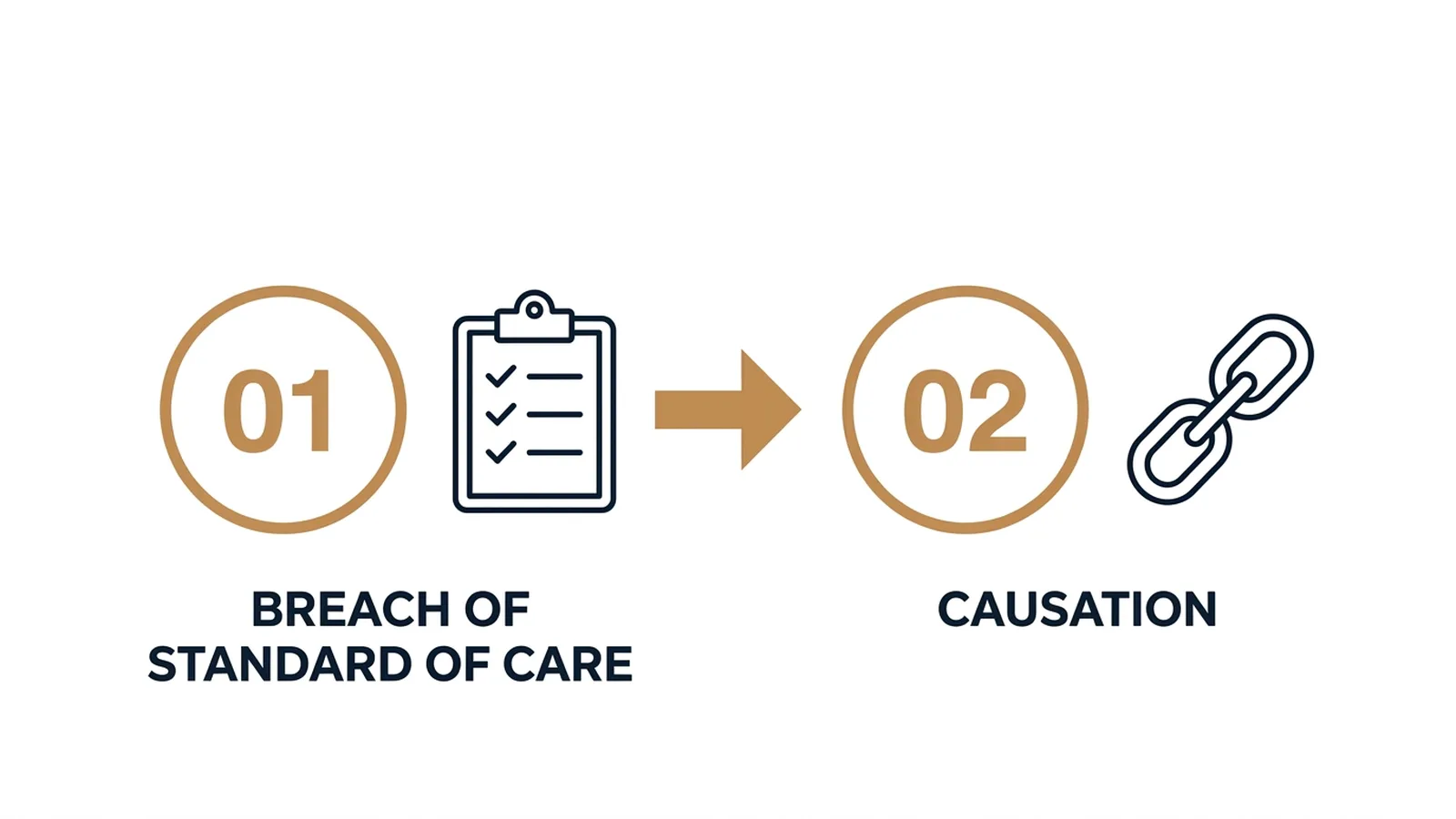
Sometimes bad things just happen, and it's not because a doctor or a nurse or a medical professional did something wrong. To sustain a medical malpractice case, they have to breach the standard of care here in Georgia and in most states for that matter. And what that means is that they don't act the way that doctors and nurses should under those circumstances. Another thing is you have to not only prove that somebody did something negligent or breached the standard of care, but further that what they did wrong actually was the cause of what happened to you.
Two proofs, not one
Standard of care is a fancy way of saying a doctor or a nurse was negligent. In a car wreck, negligence means you ran a stop sign or you were driving too fast. In medicine, it means somebody did something that generally should not be done in that medical situation.
Then comes the second proof, and it's usually the harder one. You have to show that the thing they did wrong is what caused what happened to you. That often takes two separate experts: one who says this doctor made a mistake, and another who says that mistake is what led to the catastrophic injury or the death.
Causation can be hard to pinpoint in medical cases. We think we know a lot, and they still call it the practice of medicine, because there are a lot of unknowns and a lot of moving parts in a body. It isn't a mechanical process where you download data from a vehicle and see what broke. We have to work from physical evidence and interpret what it means.
Here's how thin that line can get. I had a case where a man contracted cancer and his doctors took a year longer than they should have to diagnose it. I worked that case up. Several different doctors agreed the treating physicians fell below the standard of care, meaning the cancer should have been caught sooner. The last expert I hired was an oncologist to answer whether the delay is what killed him. And he told me no. That cancer, at the stage it was when they missed it, was going to kill him anyway. They messed up for a year, and it wasn't going to change the outcome.
I've had stroke cases that went the other way. A delay in diagnosing a stroke where, if they'd caught it early, this person would probably have walked out of the hospital. Instead they're severely and permanently cognitively impaired.
Take the identical mistake twice. Two missed strokes, same error, same kind of physician. In one, the clot breaks up on its own and the patient walks out fine despite the miss. In the other, the blood supply stays cut off long enough to do permanent damage. The doctor was equally wrong both times. Only one of them is a case, because only one has an expert willing to say the delay is what changed the outcome.
There's a practical layer under that too. These cases are extremely expensive to litigate, with multiple experts and years of work. When somebody had a bad day and recovered completely, it probably isn't a case, even where the malpractice is provable. That's not a statement about whether the doctor did something wrong. It's a statement about whether a lawsuit makes sense for your family.
The affidavit Georgia makes you file first
Now, Georgia puts a gate in front of every malpractice filing that doesn't exist in an ordinary car wreck case.
Under O.C.G.A. § 9-11-9.1, I have to file a signed affidavit from a qualified expert in the same specialty, asserting the claim has merit, before the lawsuit can even proceed. That statute rolls off my tongue at this point, because I live with it.
Same specialty means what it says. If you're suing a surgeon, you cannot get an ER doctor to sign it. You have to find a surgeon who performs the same type of procedure the surgeon who screwed up was performing, and get that person to sign off before you can file anything at all.
You don't need that in a car wreck case, and you usually don't need it in a product liability case either. Medicine gets the extra hurdle, and there's a good reason for it. A layperson can't look at a surgical outcome the way they can look at a stop sign and know instinctively that something went wrong. That isn't knowledge anybody picks up from ordinary life experience.
So sometimes we have a difficult conversation with a family, which is that there's no expert who agrees the doctor screwed up, and without one we don't have the ability to bring the lawsuit at all.
On timing, the answer is almost always two years, the same as a car wreck. There are exceptions and I would never rely on them, because they're tenuous and they demand proof you may not be able to produce. Two years is the rule of thumb, and missing it extinguishes your case forever.
The errors that are easier to see
Some categories are more straightforward than others, and it helps to know the difference before you call anybody.
A never event is exactly what it sounds like: something that should never happen in a surgery. A sponge left inside you afterward is a never event, and that can lead to infection and sepsis. You come in for an amputation of your left leg and you wake up and your right leg is gone. That's a never event. If a surgeon nicked something, that isn't one, and that's a much harder call.
An ordinary surgical complication is harder because surgery carries real known risks. You get to the hospital and they hand you a long list of things you don't understand and have you sign on the dotted line. That a complication was a known risk doesn't automatically mean there's no case. If a doctor does something during the procedure that they shouldn't have, and that's what led to the known thing happening, you can still have a claim. Proving it is difficult and it depends entirely on the surgery, because a back surgery, a kidney removal and a knee surgery are three completely different cases.
Medication and anesthesia errors are their own category, and they often come down to something startlingly small. In a hospital you're not in control. You're not the one taking the pill; it's going into your arm intravenously. Give somebody the wrong medicine, or add a zero so that ten ccs becomes a hundred, and that is absolutely a viable claim. A clerical error can produce a terrible outcome and sometimes a death.
Informed consent cases are, if I'm being honest, among the most difficult ones I handle (and thus I usually choose not to). They come down to a he said, she said about a conversation nobody wrote down. That's exactly why they push those consent documents at you, so there's something in writing. When there isn't, a jury has to decide whether they believe the doctor told you about that risk. If you're credible and you present well, and a jury likes you and trusts you, your odds go up considerably. That's a thin thing to hang a case on, and I'd tell you so up front.
Children, and the clock that runs differently
Unborn and newly born children are among the most vulnerable people in our society, and these cases sit apart from everything else in this chapter.
The birth of each of my three kids was the happiest day of my life, three times over. They were healthy from day one and they still are. To imagine that day becoming the worst day of your life instead, if a child dies during delivery, I can't fully imagine as a parent, and I've had clients who have lived it. Sometimes it's cerebral palsy, or a permanent brain injury, and it can happen very easily in a delivery room. There are protocols in place that, if they're followed, should prevent most of it.
There's a reason these cases carry the value they do, and I'll say it plainly. We value our most vulnerable higher than we value adults. If the same injury happens to me that happens to a one-year-old, that child's case is worth more, because a jury can empathize more with a one-year-old who had no ability to defend themselves.
Georgia also gives these families more time. Instead of the ordinary two years, the statute is tolled for five years from the injury, and then you have two years from that point. So a birth injury claim can be brought as long as seven years after the delivery.
The expert decides, and sometimes you ask twice
Medical malpractice is a significant part of my practice, which means I can often unpack a set of facts before an expert ever sees them. If a family describes a stroke case, I can usually work out from the records and the conversation whether it's a case. I do my own research first, using the same websites and resources the doctors use to look these things up. Only then do I bring in an expert.
Finding the right one is its own skill. Sometimes it's word of mouth, because lawyers talk. I once hired an expert who had been on the defense side against me, because I thought he did such a dang good job that he made my case difficult, and I wanted him on my side the next time. There are marketing companies that place experts, and I try to stay away from those by and large. However I find someone, they get thoroughly vetted, because how they come across to a jury matters as much as what's on their resume. At trial you want an educator, someone who can explain to twelve people why this happened and why this doctor or nurse is the reason it happened.
Experts disagree with each other, and that's normal. Usually when my expert says no, that's where the analysis stops, because we know we can't file. There was one case where I pushed back, hired a second expert, and he disagreed with the first. Being willing to ask twice, and being honest with a family about what the expert actually said rather than what everybody hoped he'd say, is part of doing this work responsibly.
I'll close this chapter with the thing I most want you to take from it. I believe most doctors and nurses went into medicine wanting to help people. But you are dealing with an industry full of large corporations slashing staff, and nobody in that building will advocate for you the way you can. If something is worrying you, your body knows. You have intuition. Don't trust anyone to be on top of it for you. Keep them on their toes and tell them every single thing that's going on, so that you never need somebody like me. That's my honest hope for you.
Common Questions
- What is the standard of care in a Georgia medical malpractice case?
- It's a fancy way of saying a doctor or a nurse was negligent. In a car wreck, negligence is running a stop sign. In medicine, it means a provider did something that generally should not be done in those circumstances. A qualified expert in the same specialty has to review your care and conclude that your provider fell below it before a case can go anywhere.
- Why is causation sometimes harder to prove than the mistake itself?
- Because proving a doctor did something wrong isn't the same as proving that error caused your injury or death. I've had a cancer case where the delay was real, and the oncologist told me the disease was going to kill him regardless. I've had stroke cases where the delay changed everything. The difference between a viable case and a dead one is sometimes razor thin.
- How long does a family have to file a malpractice claim in Georgia?
- Usually two years from the date of the injury, the same as a car wreck. Birth injury cases get significantly more time: the statute is tolled for five years from the injury, and you then have two more years from that point, allowing a claim to be filed as long as seven years after the delivery. Don't rely on other exceptions.
- What is a never event, and why is it easier to prove than an ordinary complication?
- A never event is something that shouldn't happen under any circumstances, like a surgical sponge left inside a patient or an amputation performed on the wrong leg. Because there's no legitimate medical explanation for it, these are often more straightforward to prove than a disputed complication, where the risk was disclosed and the argument is about whether anybody actually erred.
Chapter Reflection
A malpractice case rests on two separate proofs, not one. Your certainty that something went wrong is where that inquiry starts, and it is never where it ends. The expert's answer, not your instinct and not mine, is what Georgia requires before you can even file. That gate is frustrating when you are the family on the wrong side of it, and it is also what keeps the system from turning on doctors who did nothing wrong. What a jury can award once those two proofs are made is a different question entirely, and Georgia answers it without a ceiling.