
Every client eventually asks me the same question. "What is my case worth?" Whether the harm was a pedestrian crash or something that ends in a wrongful death action, this is ultimately the main question.
It is the most important question, and it is not an easy one, so I want to be careful about how I answer it. Here's the part I have to say first, and I say it to clients all the time. The question we get to decide isn't what a life is worth, or what your pain is worth. It's what your case is worth, which is a different and much narrower question, and a number of things go into that equation that have nothing to do with how badly you were hurt.
This chapter walks through those things. Two categories of damages, a third that shows up rarely, and the handful of factors that move the number without ever touching your injury.
Medical expenses, I get it, they ain't cheap, and we don't want to pay them. But when somebody thinks about their harm and what was lost, they're not thinking about the medical bills. They're thinking about what they've missed out, the grandkid they can't pick up or the loved one they'll no longer see. That's really where the true, quote unquote, 'value' of a case to me really is.
The tangible things, and the ones that matter more
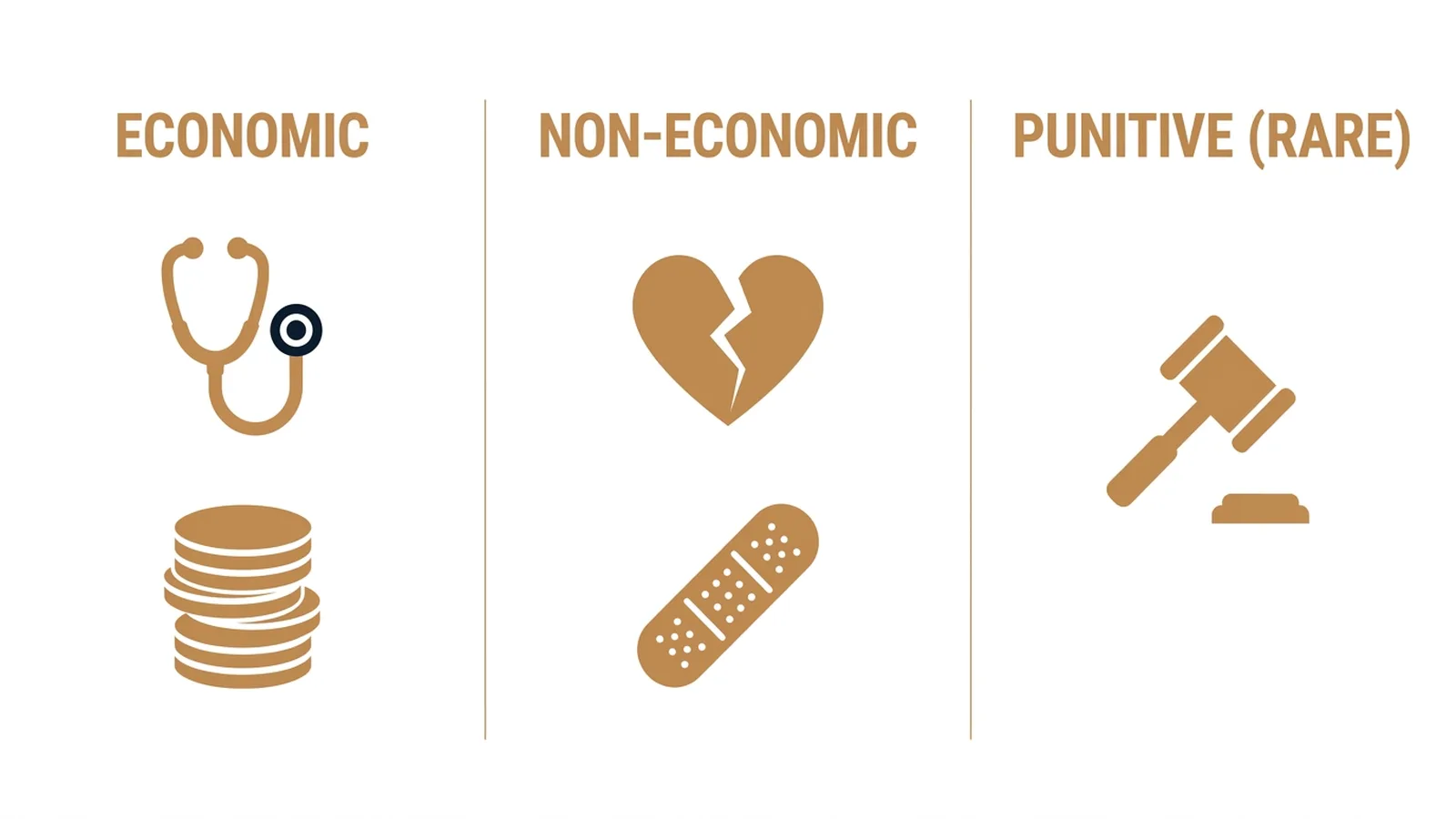
Economic damages are the tangible side. Medical bills you've already incurred. Wages you lost while you were out of work. What a life care planner says your future medical care is going to cost.
The past is the easy part. There's a bill sitting there, and the defense may put up an expert to fight about it, but if you incurred a hundred dollars in medical bills, you have a hundred dollars in past medicals. The future takes more work. If a doctor has recommended a surgery you haven't had yet and can tell a jury it's going to cost a hundred thousand dollars, Georgia lets a jury award that now, in one verdict, instead of making you come back and sue again if it happens.
Non-economic damages are the less tangible side, and frankly they're harder to put a number on. What is pain worth? Put a number on suffering. Tell me the value of somebody's life who doesn't come home.
Georgia places no statutory cap on those. The standard a jury applies is the enlightened conscience of an impartial jury, which is a fancy way of saying twelve people listen to the evidence and decide. In Georgia they have to agree unanimously.
Now, the thing I want you to hear in all of this is that the medical bills are not where the value of your case lives. At Conn Law we typically don't anchor a case to the bill total at all. I get it, medical expenses aren't cheap and nobody wants to pay them. But that's not what a person is thinking about when they think about what they lost.
Who a jury hears from
A jury doesn't reach that number off a chart, whether it's an ordinary car wreck or a wrongful death case. They hear from people who knew the person.
In a death case, that means people who knew them. In an injury case, people who still know them, and who can tell a jury what this person was like before and what this person is like now. That contrast is the evidence. It isn't a figure a lawyer suggests from a podium, because what a lawyer says isn't evidence at all.
And what they describe is usually small and specific. The grandkid you can't pick up anymore. The person who isn't at the table. That's where the real value of a case sits, and it's a genuinely hard thing for twelve strangers to price. It's hard for us as lawyers to quantify too, and I'd rather admit that than pretend there's a formula.
Pricing a future you haven't lived yet
Lost earning capacity gets confused with lost wages, and they're different things. Lost wages ask what you would already have made by now, while lost earning capacity asks a much longer question.
Say you're making fifty thousand dollars a year at thirty. You don't have to accept that as your number for the rest of your life. It stands to reason you'd probably make more at forty, and more again at fifty. If you were on a trajectory toward promotions, better benefits, a bigger role, that trajectory has value and Georgia lets you recover it. An economist is the expert who turns that into a figure a jury can actually evaluate instead of a guess.
A life care planner does the same job for your medical future, and the detail surprises people. They don't hand a jury a lump sum. They work with the doctors treating you now and the ones you'll see later, and they go item by item. How long does a wheelchair last, and when do you need the next one? If you have a spinal cord stimulator implanted, what does replacing the battery cost every five or ten years? If you're paralyzed, what does it cost to retrofit your house with bars and ramps? All of it priced out for the rest of your life.
You need that done properly, because you get one shot at this. One shot at a settlement, one shot at a trial. If your condition changes afterward in a way nobody accounted for, there is no second recovery. That's why I want the whole medical picture before I ever encourage a client to settle. You might take what looks like a favorable number today, and then need three more surgeries you never priced, and end up in the negative. That is not where we want to be.
Punitive damages, and where the ceiling goes away
Punitive damages run on a different track from the other two categories, and they're rare.
They're available under O.C.G.A. § 51-12-5.1 when a defendant acted with conscious indifference to the consequences of their conduct, and usually capped at $250,000 unless the defendant was driving under the influence, in which case that cap doesn't apply. Where a wreck proves fatal, O.C.G.A. § 51-4-2 sets out who has standing to bring a wrongful death claim: ordinarily a surviving spouse, then children, then parents, in that order. If there's no spouse, any one of several children can bring it, or they can all be named plaintiffs together. With no spouse and no children it goes to parents, and if there are no parents, it goes to the estate.
Conscious indifference is a real bar. It means somebody took an action they didn't necessarily know would injure you, but knew carried a high likelihood of it. You usually prove it with patterns and practices: a history of speeding, or a company that knew it had a habitual drunk driver and put him out there anyway.
When the cap does come off, because of a DUI or specific intent to cause harm, there is no ceiling at all. Georgia juries have returned punitive awards in the tens of millions of dollars. That category isn't there to make you whole. It's there to punish conduct and to make sure it doesn't happen to the next person.
Where a case is filed decides who hears it
Venue is one of the least visible factors in what your case is worth and one of the most consequential, and my lawyer profile shows exactly which courts I try cases in.
File in Chatham County State Court or Superior Court and your jury comes exclusively from Chatham County. The size of that jury depends on which one you are in. Superior Court seats twelve. State Court seats six unless a party asks in writing, before the trial term, for twelve, which is available once the damages claimed pass fifty thousand dollars. In a catastrophic injury or a wrongful death case that demand is one of the first things I make, so the cases in this book are twelve-juror cases either way. File in federal court and it's drawn from a much broader pool, several surrounding counties, Bryan and Effingham and Liberty among them, which means a good deal less certainty about what your jury is going to look like. In my experience Chatham County jurors are intelligent, they can follow the facts, and they have a lot of empathy. In another venue you might find people who are simply tougher about awarding a large sum.
There's a timing piece too. Superior Court these days tends to move toward trial a little faster than State Court. That isn't a knock on our state court judges, and we know they're backlogged and we're not blaming them for it. Sometimes we also have a view about which judge is likely to hear the case. None of that has anything to do with how badly you were hurt, and all of it can move what your case is worth, which is why I treat the filing decision as strategy rather than paperwork.
And from the first meeting I tell people there's no such thing as a slam dunk. You can always lose a case. You have to factor in the risk, because a Georgia verdict has to be unanimous, and one juror out of twelve going the other way changes everything.
That risk runs both directions, though. I've had a case where the insurance company's opening position was to pay nothing at all rather than negotiate. They made it very easy for my clients to go to trial, and that jury came back at sixteen million dollars. An insurer refusing to make a serious offer isn't protecting itself. It's handing the number to a jury, and juries are not always as conservative as an adjuster assumes.
One last thing that surprises people. Jurors don't automatically turn on the person who caused the harm. This comes up constantly in malpractice, where by and large jurors do not want to punish a doctor for the sake of punishing somebody, and they can feel real sympathy for a defendant while still believing that defendant made a serious mistake. That sympathy is a real thing and you have to build a case with it in mind.
Deciding whether to settle can feel like agreeing your loss was worth less than it truly was, and I understand why. If it were up to me, most of these cases would be worth more than twelve strangers are going to say. What most clients come around to is that you don't get to be the plaintiff and the juror at the same time. Settling isn't a concession about what your loss was worth. It's a decision about risk, made with the full picture, and it's yours to make, not mine.
Common Questions
- What is the difference between economic and non-economic damages in Georgia?
- Economic damages cover the tangible costs: medical bills, lost wages, and the future medical care a life care planner prices out. Non-economic damages cover what has no invoice, meaning pain, suffering, and in a death case the value of the life itself. Georgia places no statutory cap on that second category, which is left to what a jury decides is fair.
- Are punitive damages available in every Georgia injury case?
- No. They require proof the defendant acted with conscious indifference to the consequences, under O.C.G.A. § 51-12-5.1, and are usually capped at $250,000 unless the case involves driving under the influence, in which case Georgia juries have awarded far more. You typically prove that state of mind through patterns and practices rather than a single moment.
- Who can bring a wrongful death claim in Georgia?
- Under O.C.G.A. § 51-4-2, a surviving spouse has priority, followed by the deceased's children, then parents, depending on the family's circumstances. If there is no spouse, any one of several children can bring the claim or they can all be named as plaintiffs. With no spouse and no children it passes to parents, and if there are no parents, it goes to the estate.
- Does it matter which court a case is filed in?
- Yes, more than most people expect. Chatham County State and Superior Courts draw juries exclusively from Chatham County, while federal court pulls from a wider pool spanning several surrounding counties, which leaves far less certainty about who ends up in the box. The two state courts also move at different speeds, with Superior Court generally reaching trial sooner.
- What is lost earning capacity, and how is it different from lost wages?
- Lost wages cover income you have already missed. Lost earning capacity covers the higher income you could reasonably have expected over a career. Someone making fifty thousand at thirty would ordinarily make more at forty and more again at fifty, and Georgia lets you recover that trajectory. An economist is usually the expert who turns it into a number.
Chapter Reflection
A settlement number is not the sum of your medical bills. It's the economic loss, plus the human loss, plus in a rare case an accounting for conduct that endangered other people. Each of those gets proven a different way. And every one of them gets filtered through things you never chose. Which county you're in. Which judge draws the case. Whether twelve people you've never met can agree. Proving any of it looks different again when the person who caused the harm wasn't a stranger in traffic but a doctor or a nurse who was supposed to be helping you.